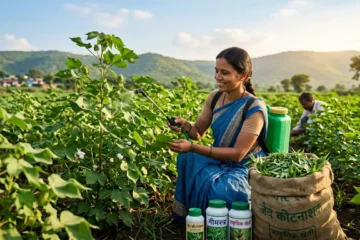

The most significant staple crop in India is wheat, second only to Paddy. Approximately 30 million hectares are covered by this crop, which yields 103 million MT annually. Despite its importance, wheat production is affected by several biotic stresses, with wheat rust being one of the most harmful diseases in India and other wheat-growing nations. Many different species of Puccinia are responsible for these diseases. With different environmental preferences, symptoms, and management approaches, each kind of rust presents distinct challenges to wheat crops. A good harvest and the preservation of your wheat crop depend on early detection and efficient control methods.
Types of wheat rust
There are three major types of rust diseases seen in wheat crops:
1. Black Rust (Stem Rust): Black rust, commonly known as stem rust. It is caused by Puccinia graminis, which infects both stems and leaves. It generates elongated, orange to dark red pustules and is more destructive, resulting in losses of up to 70%. Stem rust, the most devastating wheat disease in history, has the potential to ruin whole fields swiftly.
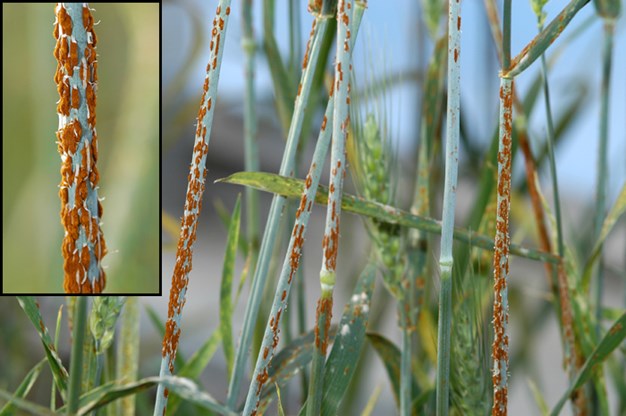
Black or stem rust of wheat
Image Source: USDA Agricultural Research Service
2. Brown Rust (Leaf Rust): Brown rust, often known as leaf rust. Puccinia triticina, which mostly degrades leaves, is to blame. The disease is identified by reddish-brown pustules on the leaf surface that flourish in cool, wet conditions. Severe cases might result in a 50% yield loss, especially if the sickness occurs before the blooming time.
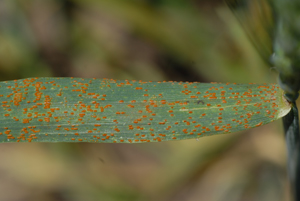
Brown or leaf rust of wheat
Image Source: Nebraska Extension Publications
3. Yellow Rust (Stripe Rust): Yellow rust is also known as stripe rust. It is caused by Puccinia striiformis, which is common in milder climates and attacks wheat early in the season. It produces yellow stripes on leaves and can lead to stunted, weaker plants, potentially resulting in yield losses of up to 100% under favourable conditions.
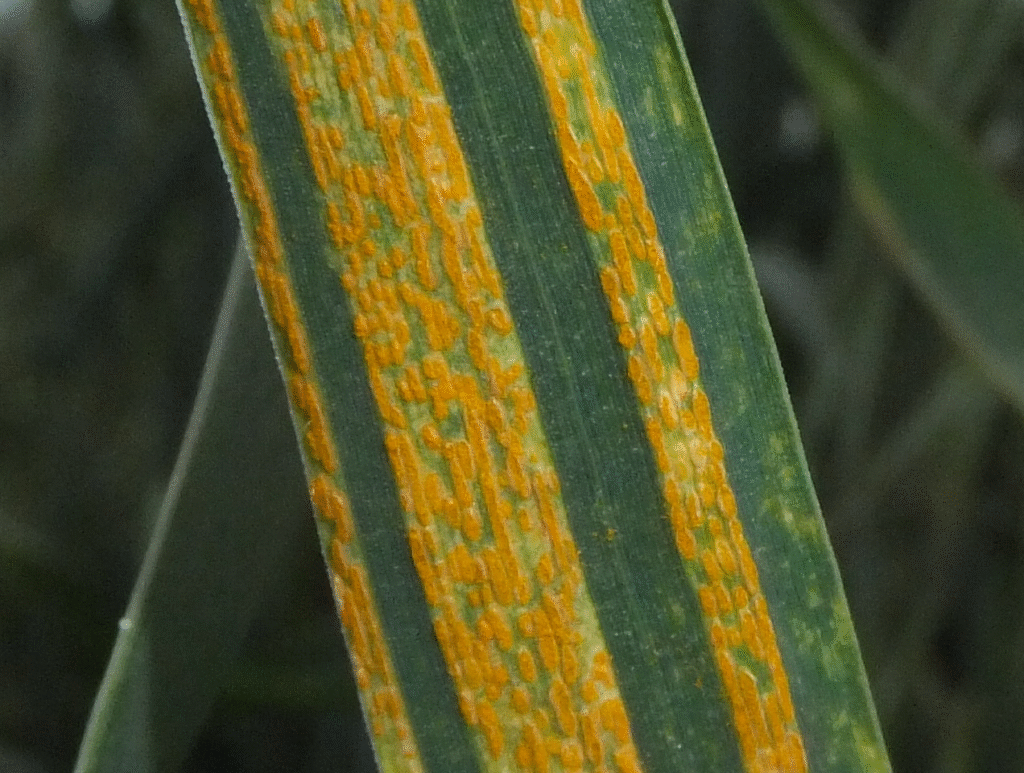
Stripe or yellow rust of wheat
Image Source: farmingUK
Lifecycle and spread of diseases
- Under warm, humid circumstances, wheat rust spores travel quickly across great distances due to wind and splashing water.
- Under ideal circumstances, new lesions appear 7–10 days after infection, and disease cycles recur rapidly.
- Recurring epidemics are made possible by rust fungi’s ability to endure between seasons by overwintering in southern areas or on other hosts.
Optimal conditions for rust formation
- Weather that is cool and muggy (10–20°C)
- Dew or persistent rains
- Poor air circulation and a dense crop canopy
- Use of vulnerable cultivars or late planting of wheat
Techniques for early detection
- Regular field monitoring: Examine the crop once a week, particularly while it is tillering and heading.
- Observing yellow or brown streaks on crops: these are early indicators of rust infestation.
- Examine the underside of the leaves: The lower leaf surfaces are frequently where rust pustules initially emerge.
- Keep an eye on nearby fields: You can take action before rust spreads if you notice it early in the area.
Control and prevention strategies
- Use resistant varieties: Select the rust-resistant wheat cultivars that are suggested for your area.
- Timely sowing: The crop can avoid serious infection by being sown early (before mid-November).
- Balanced fertilization: To boost plant immunity, stay away from too much nitrogen and maintain the right NPK ratio.
- Crop rotation: To stop the cycle of illness, switch to oilseeds or pulses instead of continuously planting wheat.
- Field sanitation: After harvest, get rid of contaminated crop remains and volunteer wheat plants.
- Chemical control: Apply fungicides (Benzimidazoles or Triazoles group) as soon as an infection appears, and if circumstances encourage the spread of the illness, repeat the application after 15 days.
Conclusion: If ignored, wheat rust may spread swiftly and drastically lower production. The best approaches to protect your wheat crop are to choose resistant cultivars, monitor your crop often, and apply fungicides on time. To identify rust early, react quickly, and safeguard your crop, early action is essential.
https://ppqs.gov.in/sites/default/files/wheat_rust-english.pdf
https://www.ars.usda.gov/midwest-area/stpaul/cereal-disease-lab/docs/barberry/black-stem-rust-biology-and-threat-to-wheat-growers/ https://www.farminguk.com/news/-unusually-high-levels-of-wheat-yellow-rust-prompts-sharp-downgrades-in-varieties_44454.html
https://extensionpubs.unl.edu/publication/g2180/na/html/view
https://www.fao.org/4/y4011e/y4011e0g.htm
https://pmc.ncbi.nlm.nih.gov/articles/PMC11396821
https://agritech.tnau.ac.in/crop_protection/crop_prot_crop diseases_cereals_wheat.html