Rashid Ali*
Introduction: Nitrogen is one of the most essential nutrients for wheat. It actively participates in promoting early vegetative growth, tiller formation, chlorophyll content, and overall production. When wheat faces deficiency of nitrogen at an early stage (15-30 DAS), the crop loses vigor, slows tillering, and eventually loses 10-30% of its production.
1. Causes of Nitrogen Deficiency in Wheat at the Early Stage?
1.1 Low Soil Nitrogen Availability: Due to the low soil organic matter, many Indian soils, like- light textured soils, create low nitrogen levels in the field.
1.2 Improper Basal Fertilizer Application: If avoiding the basal nitrogenous fertilizer dose during sowing time can cause early nitrogen deficiency in young plants.
1.3 Heavy Rain / Waterlogged Conditions: During early growth stage, continuous rainfall or over-irrigation cause:-
- Depletion: Depletion of soil-based water-soluble plant nutrients
- Leaching: Loss of fertilizer in the form of solution and move in to soil surface
1.4 Poor Seedling Establishment: Nitrogen uptake is limited by weak stands caused by poor seed quality, deep sowing, or pest disease problems.
1.5 Incorrect N:P:K Dose– Excessive phosphorus treatment without adequate nitrogen availability can result in deficient symptoms.
2. How Can, Determine Nitrogen Deficiency
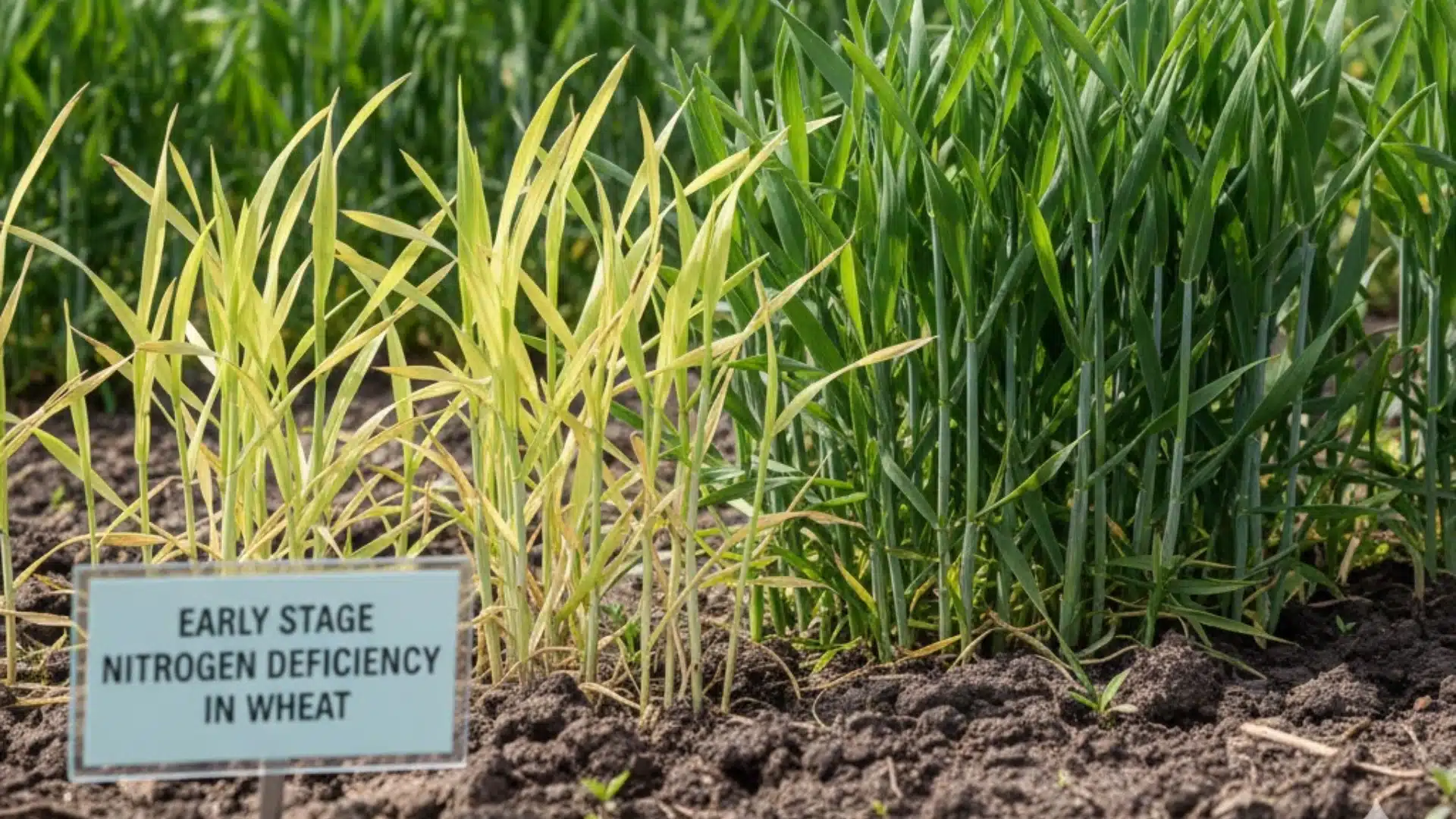
- Uniform pale-yellowing of older leaves (bottom leaves first)
- Stunted plant height
- Reduced number of tillers
- Poor, thin crop stand
- Delayed growth and weak root system
3. Remedies: How to Correct Nitrogen Deficiency Immediately
3.1 Apply Urea at CRI Stage (Most Effective)- The most critical stage for irrigation and Nitrogen supply at Crown Root Initiation (CRI) occurs at 21-25 DAS.
Recommended dose: Urea @ 20-25 kg per acre top dressing
3.2 Foliar Spray for Quick Greening
Spray:
2% Urea spray (2 kg urea in 100 Liter of water) This gives quick improvement within 3-4 days.
3.3 Correct Water Management
- Avoid waterlogging.
- Irrigate only when soil reaches mild dryness.
3.4 Add Organic Sources
- FYM / Compost @ 4-5 tons/acre
- Vermicompost @ 1 ton/acre- These improve soil nitrogen retention for the entire crop cycle.
4. Best Practices to control Nitrogen Deficiency in Wheat
4.1 Fertilizer application in wheat (Nitrogen required for wheat: 100-120 kg/ha)
Split doses:
- Basal (At sowing): 25%
- CRI stage: 50%
- Late tillering: 25%
4.2 Use Balanced Fertilizers
- DAP + Urea at sowing
- Urea at CRI and tillering
4.3 Improve Soil Health
- Increase Soil Organic Carbon:
- Crop residue incorporation
- Green manuring- Dhaincha, Sunhemp
- Reduced burning practices
4.4 Select suitable Varieties and suitable Planting Methods
- Line sowing improves nutrient uptake
- Early varieties may need earlier application of fertilizer
Conclusion
Nitrogen deficiency is one of the most dangerous and readily remedied issues in wheat. Nitrogen treatment at CRI stage, balanced fertilization, and good soil health can significantly boost crop vigor, tillering, and eventual grain output.
Source:-